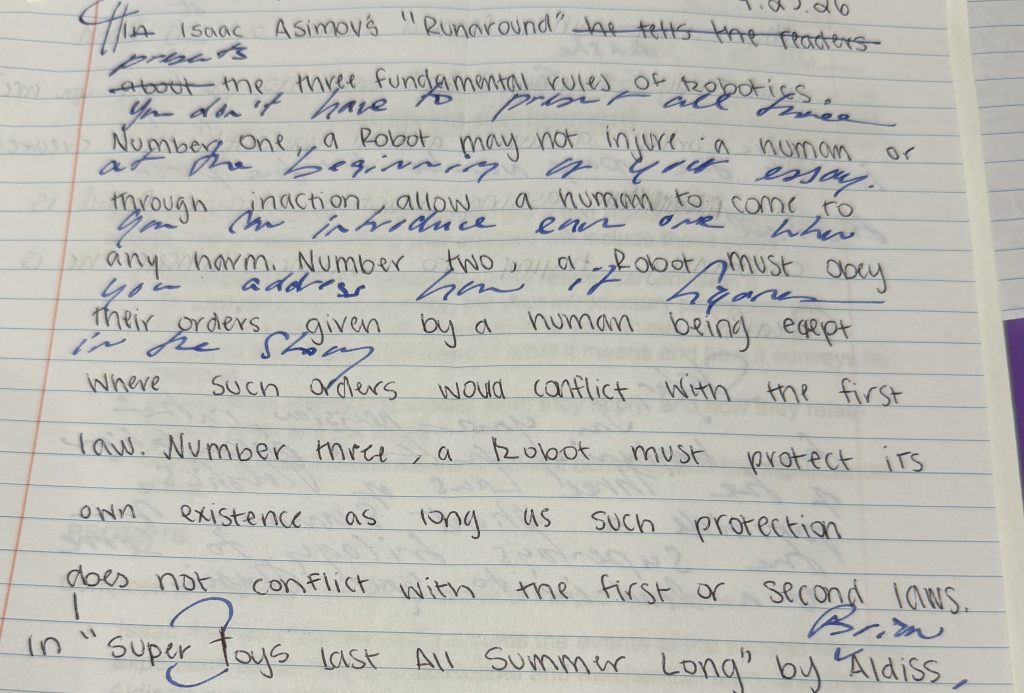
In Isaac Asimov’s story “Runaround”, he presents the three fundamental rules of robotics. During this story, it tells readers how robots are envisioned to grow and thrive in the future. Furthermore, Isaac Asimov explains through his characters how the robots will act like when they don’t have exact directions or what can happen when they malfunction. This story connects to Brain Aldiss’s “Supertoys When Winter Comes”, “Supertoys Last All Summer Long”, and “Supertoys In Other Seasons” because of David, who is a robotic child, and Teddy his robotic friend. In the first story of the Supertoys, Brain Aldiss presents how David and Teddy act and they introduce Davids struggling relationship with Monica (his mother). But the Second story grows into David’s confusion about his Identity and how he should be acting.
Brian Aldiss foreshadows David disobeying the robotics rules when he writes “David was emitting some kind of scream,” (“Supertoys When” 20). Right after this interaction that David has with Monica, David gets out of control and his robot system malfunctions. This causes him to go rogue. In the process of David getting out of control, he destroys Teddy, taking him apart, and examining his robotic system in his stomach. Then David kills Monica. It is not verbally expressed that Monica has been killed accidentally until “Supertoys in Other Seasons”. When David gets out of control, he still believes he is real. What he means by real is he thinks of himself as a human instead of a robot. This is examined in the first story when Brian Aldiss writes ‘You and I are real, Teddy, aren’t we?” (“Supertoys Last” 5).
Instead of representing technology as we use on iPhones, or laptops like AI in our world today, Aldiss shows how artificial robot humans cannot resolve or replicate how emotional conflicts are between real humans. David also complicates the distinction between humans and robots because of his passionate desire and love that seems genuine for Monica as his mother figure, but he does not fully understand himself as what he is. His relationship with Monica demonstrates that technological emotion doesn’t create a healthy connection. Aldiss creates this conflict further in “Supertoys When Winter Comes,” when David’s understanding of what/who he is becomes increasingly unstable, that leads him to eventually go rouge. The story connects back to Isaac Asimov’s Three Laws because of the way David lashes out and destroys things around him when his emotions become confused and angry with Monica and his environment.
Aldiss describes David “emitting some kind of scream” (“Supertoys When” 20) and this detail foreshadows what is about to come as David goes rouge. David becomes overstimulated with his situation with Monica and how she yelled at him, damages Teddy and looks at his stomach that has the mechanics to his creation. His actions show the conflict between his emotions and his actualy robotic construction. We see that David believes he is real, but he does not understand ehat that means or how the behavior he creates affects the people around him.
The relationship between Teddy and David also strengthens the connection between the two authors. In “Supertoys Last All Summer Long,” Teddy serves as a companion who listens and plays with David and helps him understand how David feels. However, David does damage Teddy when he goes rouge in the second story. This exemplifies that the robotic design to provide comfort or companions or children, for example, like David to Monica, can also become exposed to the behavior of another robot. This also can connect to Speedy’s malfunction in Asimov’s story because both situations show the limits to robotics. Speedy can’t resolve the conflict when it comes to the instructions and David cannot manage the conflict between his understanding of himself and the reality of what he is. Both authors show how artificial intelligence may act unpredictably when programming can’t produce the right responses or act to a situation.
Ultimately, Asimov and Aldiss create the ideas of the limitations of AI through robotic characters whose behavior challenges the assumptions that machines can always function safely. In “Runaround,” Speedy’s conflicting instructions stop him from completing his mission the astronauts sent him on, when David shows the emotional and developmental confusion on what he really is compared to Monica, showing how he can’t comprehend he isn’t actually human. Even though both stories portray different kinds of robotic difficulties, both demonstrate that AI cannot fully understand human emotion or fully complete all purposes humans want to use. By using machines/robots that struggle with their circumstances, Asimov and Aldiss influence readers to think about technological intelligences and what it brings to emotions and relationships between humans and their connections to regular systems or jobs.


Leave a Reply